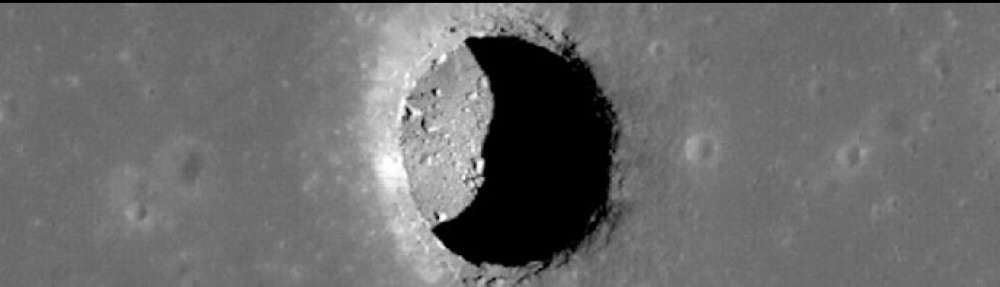
The power requirements of supporting both the robotic and follow-on manned explorations will grow over time. The simplest solution is to deploy solar arrays on the lunar surface around the hole in segments, adding new panel arrays as needs require. Power would not be generated during the 2 week lunar night, but initial exploration efforts could be limited to the two weeks of daylight by landing just after sunrise and departing just before sunset. With time, battery storage could be added so extra capacity from the solar cells could charge up systems to give some reserve.
One of the early requirements for the subsurface base will be stringing lights along the underside of the lava tube and connecting them to the solar arrays. For this, a specialty robot will be useful, one that can hold itself to the roof while stringing LED light strips and attaching them with strong anchors. These lights, in radial strips starting at the opening, will allow for illumination on the tube floor while crews are installing and deploying inflatable modules to support the human exploration teams. Protected from radiation, micrometeorites and solar flares, the tube will be a haven and safe refuge for the first extended human exploration of another world.
Once battery or alternative sources (nuclear?) are provided, lighting and power can be provided during extended periods when the solar arrays are non-functional. These periods can be short to begin with and extend over time to allow the base to grow into permanent occupation.